
The specifications of a finished bed sheet roll often tell you more about the machine you need than the machine catalogue does. A narrow medical bed sheet roll, a wider disposable bed cover, and a high-volume nonwoven roll may require very different production settings even when the basic manufacturing process appears similar.
Before comparing equipment, manufacturers need to establish what the finished roll should look like, how much material each roll should contain, and what materials will be used throughout production. Width, diameter, core size, winding quality, and required output then become practical criteria for evaluating different machine configurations.
This is where choosing a bed sheet roller machine becomes more than a capacity comparison. A properly configured non woven roll making machine should provide the required production range while keeping feeding and rewinding stable as material and product specifications change. Understanding the specifications behind these functions can help manufacturers select equipment that fits the actual production setup instead of paying for capacity or features they may not need.
The most useful specifications are those that can be directly connected to the finished product. For bed sheet roll production, material width, rewinding width, finished roll diameter, core size, production speed, and control method are among the first specifications worth checking.
Material width determines how much web can be processed by the machine, while rewinding width indicates the working range available for forming the finished roll. The core diameter also needs to correspond with the intended product and downstream handling requirements. These dimensions should be considered together rather than evaluated separately.
Production speed is another important consideration, but a higher number does not necessarily mean a better machine. A line that operates at a stable speed while maintaining proper web tension and roll formation can provide more usable output than a faster machine that requires frequent adjustment.
Atomic Ant Machinery's AA-BR-600 Bed Sheet Roll Making Machine provides a useful example of how these specifications are defined. According to its published specifications, the machine supports a maximum material width of 600 mm, a rewinding roller width of 600 mm, a 76 mm raw material paper core, a finished roll diameter of 60–120 mm, and a production speed of 120–160 m/min. These figures apply specifically to the AA-BR-600 and should not be treated as standard values for every bed sheet roller machine.
| Specification | What It Affects | What to Check Before Purchase |
|---|---|---|
| Material width | Maximum usable web width | Whether it matches the required bed sheet dimensions |
| Rewinding width | Finished roll formation | Whether the winding range fits the product |
| Finished roll diameter | Roll capacity and handling | Required diameter range and packaging compatibility |
| Core size | Roll support and handling | Core dimensions used in actual production |
| Production speed | Production capacity | Required output under real operating conditions |
| Control system | Operating stability | Level of automation and ease of adjustment |
Material compatibility should be confirmed before production capacity becomes the main focus. Bed sheet rolls can be manufactured from different substrates, and their behavior during feeding and rewinding is not always the same.
Nonwoven materials, for instance, can differ in softness, stiffness, thickness, surface structure, and tensile behavior. Paper and PP-based materials may also require different handling conditions. A machine intended to process several substrates therefore needs to provide a suitable feeding and rewinding configuration rather than relying on a single fixed setting.
Atomic Ant Machinery states that the AA-BR-600 can process nonwoven materials, paper, PP, SMS, and similar materials. This makes the equipment suitable for manufacturers whose product range includes different disposable sheet materials.
For a manufacturer evaluating a non woven roll making machine, however, general material compatibility is only the starting point. The supplier should also review the actual material specifications, including web width, grammage or thickness, roll condition, core size, and the required finished roll dimensions. Material samples can also be useful when the substrate has unusual softness, elasticity, or surface characteristics.
The objective is to make sure that the machine does not merely accept the material, but can process it consistently at the required production speed and winding quality.
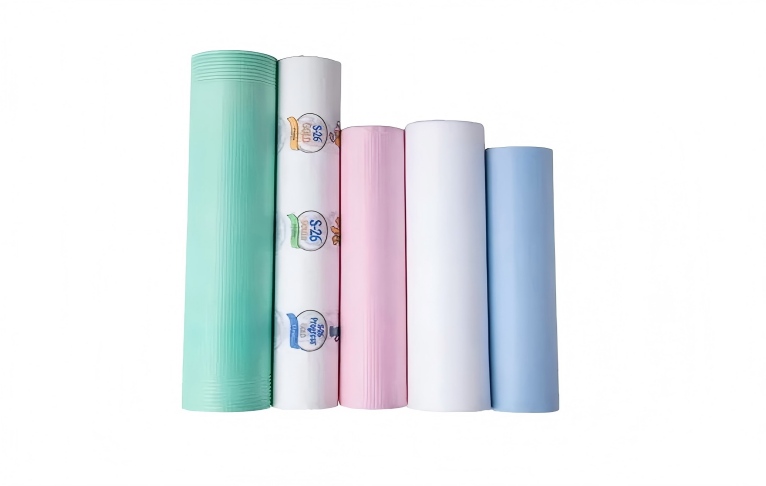
The dimensions of the finished roll have a direct influence on how the product is packaged, transported, stored, and used. A machine therefore needs to provide a finished-roll range that corresponds with the manufacturer's actual product specifications.
Roll width is usually determined by the required bed sheet or bed cover size and the width of the incoming material. If the machine's usable width is smaller than the required web, the production setup may not be suitable. If the available width is substantially larger than the actual product requirement, manufacturers should also consider whether the additional capacity provides a practical benefit.
Finished roll diameter affects how much material can be contained in each roll and how easily the roll can be handled. It can also influence packaging dimensions and storage efficiency. For some disposable medical products, a compact roll may be preferred for easier distribution, while other applications may require a larger material capacity per roll.
The AA-BR-600 specifies a finished roll diameter of 60–120 mm and a maximum material width of 600 mm. These parameters give manufacturers a clear reference point when checking whether this particular machine configuration fits their products.
When selecting a bed sheet roller machine, it is more useful to begin with the required finished roll than with the machine's maximum capability. Define the target width, diameter, core, and material quantity first, then compare those requirements against the available equipment range.
Production speed determines how quickly material moves through the line, but rewinding accuracy determines whether that speed produces usable finished rolls. During continuous operation, the material needs to remain properly tensioned and aligned as it is formed into a roll.
If winding tension is inconsistent, the finished roll may become too loose or too tight. Uneven web positioning can also result in poor edge alignment or an irregular roll appearance. These problems can become more noticeable as production speed increases, which is why speed and winding performance should always be considered together.
Atomic Ant Machinery lists a production speed of 120–160 m/min for its AA-BR-600 model. This is a published specification for that particular machine and does not mean that every non woven roll making machine should operate within the same range. Actual production performance depends on the material, roll specifications, machine settings, and operating conditions.
For equipment comparisons, manufacturers can look beyond maximum speed and ask how consistently the machine can maintain the required roll quality during normal production. Stable output, predictable winding, and fewer manual interventions often have a greater impact on practical productivity than a higher headline speed.
Product requirements rarely remain completely unchanged over the entire service life of a machine. A manufacturer may add new disposable sheet sizes, change raw material suppliers, or receive orders requiring different roll dimensions. Equipment flexibility can make these changes easier to manage.
A flexible machine should provide practical adjustment of the parameters that are likely to change between products. Depending on the machine design, these can include material width, rewinding conditions, roll diameter, and operating speed. The useful adjustment range should be compared with the manufacturer's expected product portfolio.
This consideration is particularly relevant for manufacturers serving multiple customers or markets. Different hospitals, clinics, distributors, and medical product companies may request different sheet dimensions or roll formats. A machine that accommodates several specifications can reduce the need to dedicate separate equipment to every product variation.
The broader equipment portfolio also matters when planning a production line. Atomic Ant Machinery manufactures equipment for disposable medical and nonwoven products, allowing manufacturers to review its range of nonwoven and medical product machinery when considering how the roll-making process fits into a larger production setup.
Flexibility should still have a clear purpose. A machine with a very wide theoretical range is not necessarily more valuable if the additional capability will never be used. The better approach is to identify current products, expected product extensions, and the material formats most likely to be required over the machine's working life.
As production becomes more continuous, manual intervention at every stage becomes increasingly difficult to maintain. Small differences in feeding, winding, or operating adjustments can accumulate during long production runs. Automation helps reduce this variation by coordinating machine functions through a centralized control system.
Atomic Ant Machinery's AA-BR-600 uses PLC control and a touchscreen interface, with automatic feeding and rewinding functions. These features allow operators to manage the machine through a more centralized operating process rather than relying entirely on manual adjustments.
For a non woven roll making machine, control automation can be particularly useful when several production parameters need to remain coordinated. Stable feeding supports consistent material movement, while controlled rewinding helps maintain the required roll formation. A touchscreen interface can also make production adjustments more straightforward when changing between product specifications.
Automation should not be evaluated simply by counting the number of automated functions. What matters is whether those functions address the production problems that the manufacturer actually faces. For a high-volume disposable product line, repeatability, ease of adjustment, and stable operation can be more valuable than unnecessary complexity.
The same principle applies when selecting a bed sheet roller machine. A well-matched control system should make it easier to reproduce established production settings and maintain consistent operation between batches. If the production requirements are unusual, discussing the actual material and finished roll specifications with the manufacturer before purchase can help determine whether additional customization is appropriate.
Manufacturers considering a new configuration can share their bed sheet roll specifications with Atomic Ant Machinery to discuss machine suitability, production requirements, and possible configuration options before making a final equipment decision.
Selecting the right bed sheet roll-making equipment requires more than comparing maximum speed or machine price. The finished roll dimensions, material characteristics, rewinding requirements, core size, production volume, and expected product range should all be considered as part of the same decision.
A suitable bed sheet roller machine should provide a practical operating range for the products being manufactured, while a properly configured non woven roll making machine should maintain stable material handling and rewinding when working with the required substrates. Specifications such as width, roll diameter, speed, and control architecture become meaningful only when they are connected to actual production needs.
By defining the finished product first and then matching the machine's capabilities to those requirements, manufacturers can avoid paying for unsuitable capacity, reduce production compromises, and select equipment that can support consistent output as their product range develops.
Key specifications include material width, rewinding width, finished roll diameter, core size, production speed, material compatibility, and the available control functions.
Material compatibility depends on the machine configuration. Atomic Ant Machinery's AA-BR-600 is specified for nonwoven materials, paper, PP, SMS, and similar materials.
The AA-BR-600 has a specified maximum material width of 600 mm, with a rewinding roller width of 600 mm.
The specified finished roll diameter is 60–120 mm. Manufacturers should compare this range with their actual product requirements.
Higher speed can increase output, but only when feeding and rewinding remain stable. The AA-BR-600 has a specified production speed of 120–160 m/min.
Automation helps coordinate feeding and rewinding functions, reduce unnecessary manual adjustments, and maintain more repeatable production conditions during continuous operation.
 EN
EN