
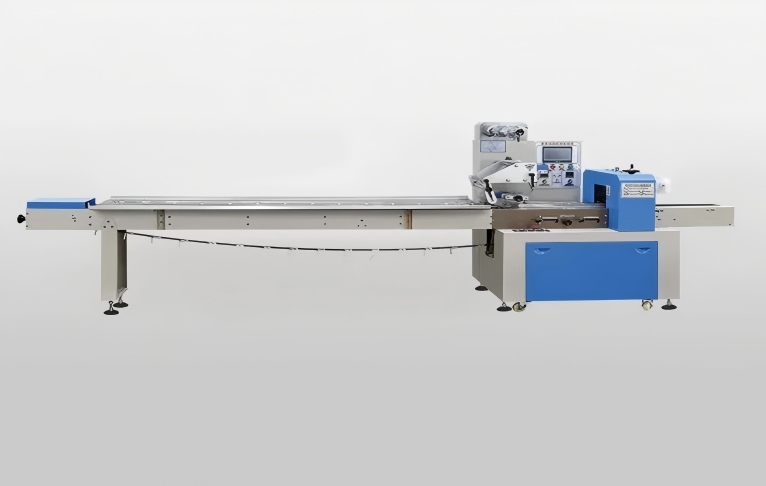
A pillow type packaging machine is well suited to daily necessities that can be continuously fed, wrapped in flexible film, longitudinally sealed, end sealed, and cut at predictable intervals. The suitability of a product depends less on its category than on its shape, stiffness, feeding orientation, film requirements, and behavior during sealing.
For daily-necessity manufacturers, this distinction matters because a machine that packages a rigid rectangular item smoothly may require a very different feeding arrangement for a soft, compressible, lightweight, or multi-piece product. Packaging performance therefore needs to be evaluated as a complete process rather than simply matching product dimensions to a machine specification.
A pillow packaging machine is particularly practical for products that can move horizontally through the wrapping process in a stable orientation.
Typical applications can include folded household cloths, disposable hygiene products, wipes, sponges, paper products, soaps, gloves, small personal-care items, and other regularly shaped consumer products. Individual items can be wrapped directly, while multi-piece packs may require additional counting or grouping equipment before entering the wrapper.
The product should maintain a reasonably predictable length as it approaches the sealing jaws. When that condition is met, the machine can maintain a stable relationship between product pitch, film movement, sealing, and cutting.
| Product Type | Main Packaging Challenge | Equipment Consideration |
|---|---|---|
| Rigid regular item | Maintaining spacing | Standard timed feeding |
| Soft product | Shape changes during conveying | Gentle product control |
| Lightweight item | Movement inside film | Stable guides and film tension |
| Multi-piece pack | Maintaining correct quantity | Counting/grouping system |
| Printed retail pack | Artwork registration | Color-mark detection |
| Heat-sensitive item | Seal temperature exposure | Precise temperature control |
The infeed system is therefore just as important as the wrapper itself.
Horizontal packaging relies on predictable product movement.
A rigid rectangular item normally has a clear leading and trailing edge. Its position remains relatively stable as the conveyor accelerates, making it easier to establish the correct cutting point between products.
Soft daily necessities behave differently. A folded wipe or lightweight disposable item may lengthen, compress, lift, or move sideways as it travels. If the actual product pitch changes, the end-sealing jaws may no longer close in the intended gap.
This is why manufacturers should avoid determining machine speed from an empty-machine demonstration. The real question is how fast the complete system can run while maintaining stable product spacing.
For upstream and downstream automation, the wrapper should be considered part of the production line rather than an isolated machine.
Packaging film affects sealing quality, package appearance, registration accuracy, and operating speed.
Film thickness alone is not enough to define compatibility. The material structure, sealant layer, coefficient of friction, print registration, temperature window, and behavior under tension all influence performance.
Printed films require especially stable control because the machine must maintain the relationship between artwork, product position, and cutting point. A gradual change in film tension can shift the print position even when product spacing remains correct.
Seal quality also needs to be tested at production speed. A setting that creates a strong seal during slow testing may perform differently when contact time becomes shorter at higher throughput.
Increasing sealing temperature should not be the automatic response to a weak seal. Excessive heat can distort the film, create poor-looking seals, encourage sticking, or narrow the usable processing window.
The correct speed is the highest sustainable rate at which products are fed, sealed, cut, and discharged without creating unacceptable rejects.
The limiting factor is often not the packaging machine itself. Manual loading, automatic feeding, upstream converting equipment, or downstream collection can determine the actual line output.
Manufacturers should evaluate product arrival consistency, spacing between products, film roll change time, SKU changeover time, sealing stability, and reject rate during continuous production.
The purpose is not to run at the highest possible number displayed on the control panel. It is to maximize good packages over a complete shift.
A machine operating slightly below its theoretical maximum but requiring fewer stops can deliver higher effective productivity.
The two technologies address different requirements.
Pillow packaging forms flexible film around the product and is particularly useful for individual retail-style wrapping. Vacuum packaging removes air from the package and is more suitable when manufacturers need to reduce volume, restrict product movement, or tightly contain compressible goods.
For bulky textile products or soft household items where volume reduction is important, a vacuum bag packing machine may therefore be more appropriate.
This distinction should be made before machine selection. Trying to force a highly compressible product into a normal pillow-pack process can cause unstable feeding or place unnecessary stress on the film and seals.
In some factories, both technologies may be used for different SKUs because they solve fundamentally different packaging problems.
Products intended for medical or hygiene applications may require more controlled handling than ordinary household goods.
The packaging process may need to reduce manual contact, connect directly with an upstream converting line, maintain predictable product orientation, or support a more controlled production environment.
In those cases, a dedicated medical packaging machine may provide a more suitable basis for the project than treating the application as a standard consumer-goods wrapping task.
The correct choice depends on the product, production environment, downstream requirements, and the level of automation expected.
Manufacturers should also distinguish packaging from sterilization. A package being produced automatically does not by itself mean that the final product meets a particular sterile barrier requirement. Material selection, sealing validation, sterilization method, and applicable quality standards need to be considered separately for regulated products.
Yes, and this is often where automation delivers the greatest improvement.
Suppose a factory produces disposable pillow covers and then packages them individually. If the output from a pillow cover making machine can be consistently oriented and spaced, the packaging stage can potentially receive products automatically rather than relying entirely on manual loading.
The difficulty is synchronization. The converting machine may release products in batches or at variable intervals, while the wrapper requires predictable spacing. A transfer conveyor, buffering section, counting mechanism, or servo-controlled feeding system may therefore be needed between the two processes.
When designing an integrated line, manufacturers should define the interface between machines early. Transfer height, product direction, spacing, accumulation capacity, and line-stop communication all influence overall performance.
Testing should use the real product and intended packaging film whenever possible.
First check product feeding. The item should enter the forming section without turning, bunching, or changing position. Next examine package dimensions and artwork registration. Then inspect longitudinal and transverse seals for consistency.
Continuous operation matters more than a handful of good sample bags. Some issues only appear after film tension changes, machine temperature stabilizes, or products have been fed for an extended period.
Changeovers should also be tested if the same line will run several product sizes. Operators need to understand which settings are recipe-based and which require mechanical adjustment.
A useful acceptance trial evaluates not only whether the machine can make a package, but whether it can repeatedly make acceptable packages under conditions similar to normal factory production.
Pillow-type packaging is highly versatile for daily necessities, but good results depend on coordinating product feeding, film control, sealing, cutting, and upstream automation.
Manufacturers should base equipment selection on real product behavior rather than product dimensions alone. Evaluating shape, compressibility, feeding stability, packaging film, required speed, changeover frequency, and line integration before machine configuration helps reduce rejects and creates a more reliable production process.
Many regularly shaped household, hygiene, textile, paper, and personal-care products can be suitable. The key requirement is that the product can be fed and positioned reliably during horizontal wrapping.
Usually yes, provided the required sizes remain within the machine's working range. Bag length, film width, guides, feeding position, and sealing settings may need adjustment between products.
Possible causes include unsuitable film, incorrect sealing temperature, insufficient pressure or contact time, contamination in the sealing area, or worn sealing components.
It is primarily a wrapping method rather than a compression process. If substantial air removal or volume reduction is required, vacuum packaging may be more suitable.
 EN
EN