
A medical drape folding machine should be configured around the actual construction of the surgical drape rather than selected by speed or maximum material width alone. Plain drapes, fenestrated drapes, adhesive drapes, reinforced drapes, and large procedure drapes can all require different feeding, cutting, hole-positioning, folding, and stacking sequences. When these functions are not properly matched to the product, high machine speed does little to improve usable output.
For manufacturers producing several drape formats, the key is to define how each product moves from an open web to its final folded size. That process determines the required machine architecture and how much flexibility can realistically be built into one line.
The basic job of a folding line is straightforward: feed the material accurately, cut it to the correct length, create the required folds, and discharge a repeatable finished product. Surgical drapes become more demanding when additional features must remain correctly positioned throughout that process.
A plain drape may require only controlled feeding and multiple folds. A fenestrated drape adds a hole whose position must remain accurate after every subsequent fold. Adhesive tape introduces another registration point. Reinforcement panels create additional challenges because two materials must be brought together without shifting.
| Surgical Drape Type | Main Processing Requirement | Critical Control Point |
|---|---|---|
| Plain drape | Cutting and programmed folding | Final folded dimensions |
| Fenestrated drape | Die cutting or hole punching | Hole registration |
| Adhesive drape | Tape or adhesive application | Adhesive position |
| Reinforced drape | Secondary material placement | Layer alignment |
| Large procedure drape | Wide-web feeding and multi-step folding | Web tension and fold repeatability |
This is why manufacturers should provide both an unfolded drawing and a finished folded sample when specifying equipment.
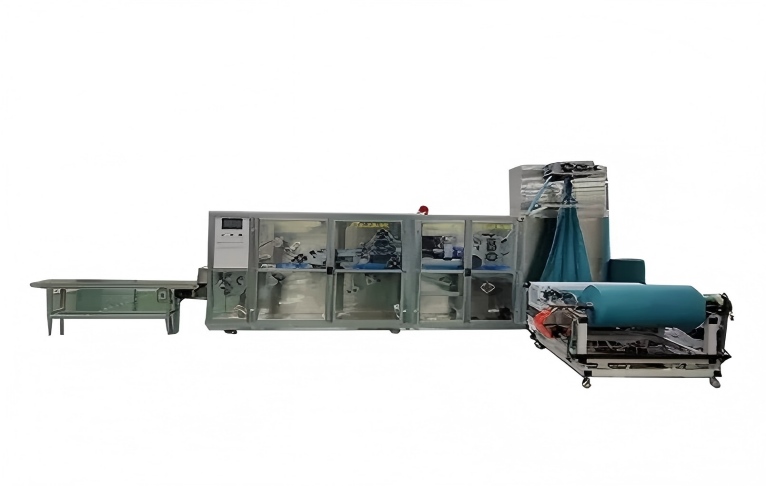
Yes, but the practical range depends on how similar the products are.
Changing finished length or moving a fold position is normally easier than changing the fundamental folding logic. If one product requires only longitudinal folding while another requires repeated cross folds, hole punching, tape application, and reinforcement, the second product may require additional modules.
For products built around repeated half-folding, a fabric double folding machine can be a useful reference point when evaluating how a dedicated folding architecture handles a specific sequence. The important question is not simply whether the machine is adjustable, but which parts of the process are adjustable without changing hardware.
Manufacturers planning multiple SKUs should therefore identify three representative products before equipment configuration: the smallest, the largest, and the most structurally complex. If the proposed line can run these reliably, the remaining products are usually easier to assess.
Two surgical drapes with identical open dimensions can behave very differently on a production line if their folding maps are different.
Consider a large rectangular drape that must first be folded longitudinally and then cross-folded several times. If the first fold is displaced by only a small amount, every later fold inherits that error. By the time the product reaches the stack, the deviation may be large enough to affect package size or the position of a fenestration.
The same principle appears in other large flat-product applications. A bed sheet folding machine must also control the relationship between material alignment, product length, and sequential folds. Surgical drapes add another level of complexity when functional features must remain correctly located within the finished product.
For this reason, folding accuracy should be evaluated across the entire process rather than only by measuring the final stack.
Material specification has a direct effect on machine behavior.
A light, soft nonwoven may move easily through guides but can also stretch, wrinkle, or shift laterally. A heavier laminated construction may track more steadily but resist tight folding. Surface friction influences how the web moves through rollers, folding plates, and guides.
The difference becomes particularly important when the drape contains an adhesive strip or punched opening. A web that drifts by several millimeters can still produce what appears to be a rectangular folded product, yet the functional area may no longer sit where the end user expects it.
Manufacturers comparing a specialized drape line with a general non woven folding machine should therefore pay close attention to registration control rather than assuming all nonwoven folding processes behave the same way.
Machine trials should use the actual intended material rather than a substitute chosen only because it has a similar basis weight.
During testing, manufacturers should also check whether the material remains stable during acceleration and continuous production. Some feeding problems appear only after the machine reaches normal operating speed.
The most efficient equipment projects begin with product information rather than a generic machine specification.
Manufacturers should define the open dimensions, final folded dimensions, material width, material type, folding direction, number of folds, hole location, reinforcement position, adhesive location, and expected output format. If several products will share one machine, the complete SKU range should be reviewed before mechanical design is finalized.
A physical sample is particularly useful because drawings do not always communicate the exact direction in which a surgical drape should unfold.
| Product Information | Why It Matters |
|---|---|
| Open drape size | Defines material and working width |
| Final folded size | Determines folding sequence |
| Material construction | Influences tension and feeding |
| Fenestration position | Determines punching registration |
| Adhesive location | Defines application position |
| Reinforcement area | Determines secondary material feeding |
| Production target | Influences required automation level |
| Downstream pack size | Affects final fold dimensions |
Product design and machine design should be treated as one engineering problem rather than two separate decisions.
Folding consistency becomes even more important when the drapes move directly into automated packaging.
A folded product that varies in width or thickness may not enter the next process consistently. Irregular stacks can affect product transfer, package length, sealing position, and the ability to maintain a stable production rhythm.
Factories planning a connected line can also review how medical packaging equipment fits into the broader production process before deciding on transfer height, discharge orientation, spacing, and buffering requirements.
The packaging format can also influence the folding map itself. If a drape must fit within a particular pouch or package, the finished dimensions should be confirmed before the folding sequence is locked.
An acceptance test should demonstrate production conditions, not just machine movement.
The correct material should be loaded, the specified product should be run at a realistic operating speed, and all required functions should be active. If a drape requires hole punching or adhesive application, those functions need to be tested together with folding rather than evaluated separately.
Samples should be taken from different points during the run. Measure overall cut length, individual fold positions, fenestration location, adhesive position, final folded dimensions, and stack consistency.
If several SKUs are planned, changeover testing is also valuable. A machine may run each product successfully but still create excessive downtime if switching between them requires lengthy mechanical adjustment.
Speed should be evaluated only after the product remains stable. A higher nominal output has little value if operators must continually stop the line to correct alignment or remove defective products.
Selecting a medical drape folding machine is ultimately a product-engineering exercise. The most suitable configuration depends on the drape's structure, material behavior, folding map, fenestration, adhesive and reinforcement requirements, finished dimensions, and relationship with downstream processes.
Manufacturers that provide detailed product drawings, physical samples, actual nonwoven materials, and realistic production requirements before equipment configuration are better positioned to achieve stable folding quality across different surgical drape formats.
Yes, provided the sizes and folding sequences remain within the machine's designed adjustment range. Products with substantially different constructions may require additional tooling or modules.
Registration is critical. The hole must remain correctly positioned relative to the finished folded product, so material tracking and synchronization between punching and folding need to be stable.
Yes. Materials with similar nominal weights can behave differently during feeding and folding. Actual production material provides a more reliable basis for validating machine performance.
No. Stable usable output, fold repeatability, registration accuracy, changeover time, and compatibility with the required product range are usually more important than maximum rated speed alone.
 EN
EN