
Choosing the right packaging equipment often starts with a simple question: what does the finished package need to do for the product? Some applications mainly require consistent wrapping, reliable sealing, and efficient production, while others need the package to contain as little air as possible. These differences can make one packaging process much more suitable than another, even when both machines appear capable of handling the same type of product.
Two of the most commonly considered solutions are roll-film packaging and vacuum bag packaging. A pillow type packing machine forms a package directly from a continuous film roll, while a vacuum bag packing machine uses a pre-made bag and removes air before sealing. The distinction affects not only the appearance of the finished package, but also the packaging material, production workflow, sealing method, and achievable throughput.
For manufacturers comparing these two options, the better choice is rarely determined by machine price or rated speed alone. Product characteristics, packaging requirements, material compatibility, production volume, and the required level of protection all need to be considered together. Atomic Ant Machinery provides both types of packaging solutions, making it possible to evaluate the packaging process according to the actual application rather than selecting equipment based on a single specification.
The most important difference lies in how the package is created and what happens to the air inside it.
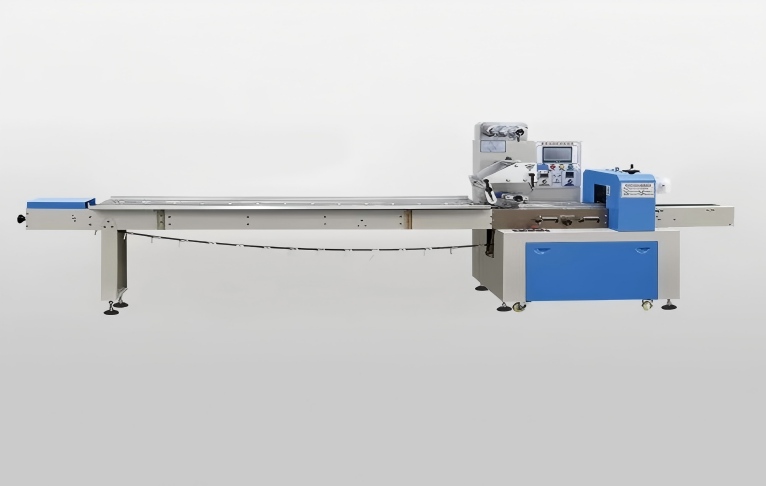
With a pillow type packing machine, packaging film is supplied from a roll and formed around the product during the packaging process. The machine creates a longitudinal seal and then seals and cuts the ends of the package. The finished package has the familiar pillow-like shape associated with horizontal flow wrapping.
This continuous process is particularly useful for products that can be fed into the machine at a steady rate. There is no need to prepare an individual bag for every product because the machine creates the package directly from the film roll.
A vacuum bag packing machine follows a different process. The product is placed inside a pre-made bag, after which air is extracted from the bag before the opening is sealed. Instead of forming the bag during the packaging cycle, the machine focuses on vacuum extraction and sealing.
That difference affects the entire production workflow. Pillow packaging is primarily designed around continuous wrapping and sealing, whereas vacuum packaging adds air extraction as an essential part of the cycle.
| Comparison Factor | Pillow Type Packaging | Vacuum Packaging |
|---|---|---|
| Package formation | Formed from roll-fed film | Uses pre-made bags |
| Air removal | Not normally part of the standard process | Air is extracted before sealing |
| Sealing | Longitudinal and end seals | Opening of the pre-made bag is sealed |
| Production process | Continuous wrapping, sealing and cutting | Bag loading, vacuum extraction and sealing |
| Main advantage | Efficient continuous packaging | Reduced air volume and airtight packaging |
| Typical consideration | Suitable when vacuum protection is unnecessary | Suitable when air removal is important |
Packaging material is closely connected with machine selection. A film or bag may appear suitable for an application, but its sealing characteristics, thickness, structure, and dimensions still need to match the equipment.
A pillow type packing machine normally works with heat-sealable flexible film supplied in rolls. Atomic Ant Machinery's PP-200, for instance, is designed for materials including BOPP composite film and aluminum film. Its specified film width is up to 440 mm, while the machine accommodates different product and bag dimensions within its operating range.
Because the film is formed into the package during operation, the film roll becomes an important part of the production setup. Film width, material structure, sealing performance, and product dimensions can all influence whether the packaging process runs smoothly.
A vacuum bag packing machine works with pre-made bags instead. Atomic Ant Machinery's VP-100, for example, supports packaging materials including composite film, PE, and PP and is designed for specified bag dimensions. The use of pre-made bags can be useful when a particular bag construction, material, or packaging appearance has already been established for a product.
Material compatibility should always be confirmed before production. Differences in sealing temperature, thickness, surface structure, or mechanical strength can affect the finished seal even when two packaging materials appear similar.
For medical and healthcare applications, packaging material can become even more important because the package may need to meet specific protection and handling requirements. Atomic Ant Machinery provides packaging solutions for medical products using different packaging structures according to the application, making it important to evaluate the actual product and material before selecting equipment.
The physical characteristics of the product usually provide the clearest starting point when deciding between the two systems.
A pillow type packing machine is a practical option for products that can be continuously conveyed, wrapped, and sealed without removing the air inside the package. Flat products, regularly shaped items, disposable products, hygiene products, and many daily-use products can be suitable for this type of packaging, provided their dimensions and feeding requirements fall within the machine's capabilities.
The process is particularly useful when manufacturers want consistent packages at a relatively high production rate. Once product feeding and film handling have been properly configured, the machine can repeat the same wrapping and sealing cycle continuously.
A vacuum bag packing machine becomes more relevant when the package needs to contain less air after sealing. Products that benefit from compact packaging, reduced internal air volume, or airtight sealing may be better candidates for vacuum packaging.
Vacuum packaging is not automatically the better choice simply because it provides an additional function. Some products may be compressed or deformed during vacuum extraction, while others gain little practical benefit from removing air. In such cases, adding a vacuum process can introduce additional complexity without solving a meaningful packaging problem.
Product shape also deserves attention. Irregular products, products with sharp edges, delicate surfaces, or components that may interfere with sealing should be tested before final equipment selection. A machine that performs well with one product may require a different configuration when product dimensions or packaging materials change.
Speed is often one of the first specifications manufacturers compare, but it needs to be considered alongside the complete packaging cycle.
A pillow packaging process can be highly efficient because film is continuously formed, wrapped, sealed, and cut. Atomic Ant Machinery's PP-200 pillow type packing machine, for example, is specified at 30–220 bags per minute. The actual production rate depends on factors such as product dimensions, feeding stability, film characteristics, and machine configuration.
Vacuum packaging normally involves more steps within each cycle. The product must be loaded into a pre-made bag, air must be extracted, and the bag opening must then be sealed. Atomic Ant Machinery's VP-100 vacuum bag packing machine is specified at 5–15 bags per minute.
These figures represent the rated ranges of two specific Atomic Ant machines rather than universal industry standards. Actual throughput varies between machine models and applications, so a headline speed should not be used as the only basis for comparison.
The sealing method is another major distinction. Pillow packaging creates the package while the product moves through the machine, with longitudinal and transverse sealing forming the finished package. Vacuum packaging seals a pre-made bag after air extraction. The appropriate method therefore depends on the required package structure and product protection as much as production speed.
Vacuum packaging becomes a stronger candidate when removing air is an actual requirement of the package rather than simply an additional machine function.
A vacuum bag packing machine can reduce the amount of air remaining inside the sealed bag, creating a more compact package and an airtight packaging format. For products where this characteristic contributes to protection, storage, transportation, or presentation, vacuum packaging can provide a meaningful advantage.
The use of pre-made bags can also be beneficial when a manufacturer already has a defined bag size, material structure, or printed packaging format. In that situation, a vacuum bag machine can fit naturally into an established packaging workflow.
On the other hand, there is little reason to introduce vacuum extraction when the product simply needs to be wrapped and sealed. A pillow type packing machine can provide a more straightforward continuous process when reducing internal air is not part of the product's requirements.
The practical question is simple: does removing air provide a benefit that matters to the product or the end customer? If it does, vacuum packaging deserves closer evaluation. If it does not, pillow packaging may provide the more efficient approach.
The best machine is the one that fits the complete packaging process rather than the one with the highest speed or the largest number of functions.
Product characteristics provide the logical starting point. Length, width, height, weight, shape, surface characteristics, and feeding method all affect how the product can enter the machine and how the package needs to be formed around it. Products that look similar from a commercial perspective can behave very differently during automated packaging.
The required package should then be defined. If the objective is a continuously formed flexible package, a pillow type packing machine may be the natural starting point. If the package needs to be made from a pre-made bag and air must be removed before sealing, a vacuum bag packing machine is more appropriate.
Packaging material should be evaluated at the same time. Film-based pillow packaging depends on the characteristics of the roll film, while vacuum packaging depends on the performance and dimensions of the pre-made bag. Sealing compatibility is particularly important because a good-looking package has little value if its seal cannot remain stable during handling and transportation.
Production requirements also need to be realistic. A manufacturer's rated speed provides a useful reference, but it does not guarantee that every product will reach that figure during normal production. Product feeding, loading, film or bag changes, inspection, and other operating conditions can all influence actual output.
For manufacturers comparing different configurations, Atomic Ant Machinery's packaging machine range provides a useful starting point for reviewing available equipment and packaging solutions. The final choice can then be narrowed down according to product dimensions, packaging material, package format, and production requirements.
A machine test using the actual product is often the most useful step before purchase. It allows the manufacturer and equipment supplier to evaluate feeding stability, sealing quality, package appearance, material compatibility, and achievable production speed under realistic conditions. Once these requirements are clear, manufacturers can discuss their packaging application with Atomic Ant Machinery and determine which configuration is most suitable.
A pillow type packing machine and a vacuum bag packing machine are built around different packaging processes, so neither should be considered universally better than the other.
Pillow type packaging is generally well suited to products that can be continuously wrapped with roll-fed film and do not require air extraction. Its continuous forming, sealing, and cutting process can make it an efficient choice for applications where production efficiency and consistent package formation are important.
Vacuum packaging is more appropriate when removing air and sealing a pre-made bag are meaningful parts of the packaging requirement. The additional vacuum step adds complexity, but it can be worthwhile when compact or airtight packaging provides a genuine benefit.
For manufacturers deciding between the two, the most reliable approach is to evaluate the actual product, packaging material, package dimensions, production target, and protection requirements together. This makes it easier to select equipment based on the real production process rather than relying on a simple comparison of machine specifications.
A pillow type packing machine forms the package from roll-fed film, while a vacuum bag packing machine uses a pre-made bag and removes air before sealing.
It can be faster when continuous film packaging is suitable. Atomic Ant Machinery's PP-200 is specified at 30–220 bags per minute, while its VP-100 is specified at 5–15 bags per minute. Actual output depends on the product and operating conditions.
Standard pillow type packaging does not include the air-extraction process used in vacuum packaging. It forms, seals, and cuts the package around the product.
A vacuum bag packing machine is worth considering when reduced internal air volume, airtight packaging, or a pre-made bag format is important to the application.
Yes. Depending on the product and packaging requirements, medical and healthcare products can be packaged using either pillow type or vacuum packaging equipment.
Product dimensions, product photos or samples, packaging material, desired bag dimensions, target production rate, and packaging requirements are useful for determining the appropriate machine configuration.
 EN
EN