
When a folded non woven product comes off the production line, the finished piece may look simple, but achieving the same fold position and dimensions from one piece to the next requires much more than a precisely positioned folding mechanism. The material has to move steadily through the line, remain properly aligned, and respond consistently as it passes through each folding stage. Cutting must then take place at the right point in relation to those folds.
Small variations can become noticeable when production continues for hours. A slight change in web tension can alter the effective folding position. Lateral movement can make one edge less even than the other. A difference in cutting timing can leave the finished product longer or shorter than intended. These issues are closely connected, which is why folding accuracy is best approached as a complete production process.
For manufacturers producing medical drapes and other disposable non woven products, an automatic fabric folding machine can bring feeding, alignment, folding, conveying, and cutting into a coordinated process. Atomic Ant Machinery develops non woven folding equipment for applications including medical drapes, with configurations designed around different folding patterns and product requirements. Its equipment combines automated control with mechanical folding and conveying functions rather than treating folding as a standalone operation.
The condition of the material entering the machine has a direct effect on what happens later in the folding section. Non woven fabrics are not mechanically identical. Their thickness, stiffness, softness, surface structure, and resistance to stretching can vary according to material composition and manufacturing process.
A softer material, for instance, may react more noticeably to changes in tension. If the web stretches as it passes through the feeding section, the distance between two intended fold positions can change even though the machine itself has not been adjusted. Material with uneven tension across its width can behave differently again, with one side moving slightly ahead of the other.
Atomic Ant Machinery specifies its medical drape folding machines for non woven materials in the 30–80 gsm range, including structures such as SS, SSS, SSMMS, SMS, SMMS, and SMMSS. These are the specifications stated for its particular medical drape folding equipment and should not be treated as a general limitation for every machine in the market.
The condition of the roll matters as well. Poor winding, damaged edges, inconsistent thickness, or changes in roll hardness can influence how smoothly the web enters the folding section. When a folding problem appears suddenly after a material change, checking the material itself can be more productive than immediately changing the folding parameters.
Feeding tension needs the same level of attention. Too much tension can stretch the material and affect its dimensions, while too little tension can allow wrinkles or uncontrolled movement to develop. The useful target is stable movement, not simply higher or lower tension.
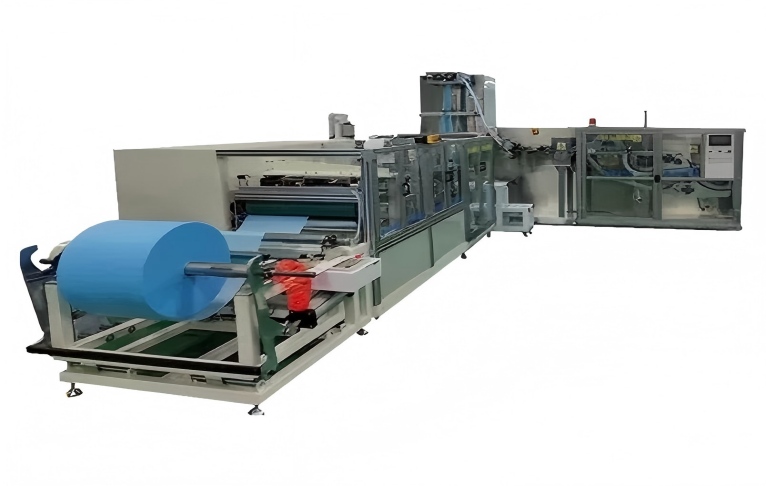
Once the material is stable, its position across the machine width becomes the next concern. A folding mechanism can be mechanically accurate and still produce inconsistent results if the web gradually moves away from its intended path.
Consider a product that needs several folds across its width. If the web shifts slightly before the first folding stage, the first fold may already be off position. That error then becomes the starting point for the next fold. By the time the product reaches the final folding stage, what looked like a small alignment problem at the beginning can become an obvious dimensional difference.
For this reason, web alignment should be established before the material reaches the folding components. Rollers, guides, sensors, and correction mechanisms need to keep the web moving along a predictable path without introducing unnecessary tension.
This is one area where modern textile folding equipment can provide a meaningful advantage. Automated correction can compensate for small lateral deviations instead of relying entirely on an operator to make manual adjustments. Atomic Ant Machinery incorporates automatic correction and reset functions into its non woven production equipment, while its medical drape folding systems use coordinated conveying and control to help maintain stable material movement.
When a fold begins to move out of position, it is tempting to adjust the folding mechanism immediately. In practice, it is worth checking the web path first. If the material is already drifting before it reaches the folding section, changing the folding position may only conceal the underlying problem temporarily.
| Process Factor | What Can Change | Why It Matters |
|---|---|---|
| Material tension | Web length and movement | Can shift fold spacing and finished dimensions |
| Web alignment | Position across machine width | Can produce uneven or off-center folds |
| Folding geometry | Fold width and sequence | Determines the dimensions of the finished product |
| Cutting synchronization | Cut position relative to folds | Affects finished length and product consistency |
| Material variation | Folding behavior between rolls or batches | May require different machine settings |
Once the web is moving in the correct position, the folding geometry determines where that material is actually folded. This becomes more complicated as the product requires multiple folds because every folding stage is connected to the one before it.
For a simple single-fold product, the relationship between material travel and fold position is relatively straightforward. A medical drape with several longitudinal and horizontal folds is different. The first folding stage establishes the geometry that subsequent stages have to work with, so an error introduced early in the process can carry through to the finished product.
Atomic Ant Machinery's medical drape folding equipment illustrates this difference through its various configurations. Its two-fold medical drape folding machine uses longitudinal zigzag folding followed by two horizontal folds, while its three-fold version adds another horizontal folding stage. The machines are therefore configured around the required finished product rather than using one universal folding arrangement.
Dimensional control is easier to manage when the finished product is defined first. The required width, length, and folding pattern provide the reference for determining how the material should move through each stage. This is more reliable than adjusting individual folding components without considering their effect on the complete product.
An automatic fabric folding machine can also make product changeovers more repeatable when several sizes are manufactured on the same line. Atomic Ant Machinery's medical drape folding machines use PLC control and a touch-screen HMI, allowing operating parameters to be adjusted for different product requirements.
Even so, the first acceptable piece after a setup change does not necessarily prove that the process is stable. The more useful test is whether the same fold positions and finished dimensions remain consistent after continuous production begins.
Folding and cutting are closely related because the cutting point determines where one finished product ends and the next one begins. If the material reaches the cutting section at a different position from the one expected by the folding sequence, the final product can have the correct folds but the wrong overall length.
This is particularly noticeable on products where the final fold needs to sit at a defined distance from the cut edge. A small timing difference can change that relationship even if the cutting blade itself is functioning normally.
That is why integrated control is preferable to treating the folding and cutting sections as unrelated machines. The feeding speed, folding sequence, conveying movement, and cutting action need to remain synchronized throughout the cycle.
Atomic Ant Machinery integrates cutting and conveying functions into its medical drape folding systems. Its equipment uses servo-controlled cutting and adjustable cutting lengths for different drape sizes, allowing the cutting operation to be coordinated with the rest of the folding process.
The same principle applies when a product includes additional features such as adhesive application, reinforcement areas, or holes. Their position is determined by what happens earlier in the production sequence. If the web has already moved out of position before reaching the feature-processing station, correcting that station alone will not restore the intended product geometry.
For quality control, it is therefore more useful to inspect the relationship between the cut and the folds than to measure either one separately. The finished product is the final reference.
There is no universal machine setting that produces the same folding result for every non woven material. Even two products made from the same general material category may require different settings if their dimensions, folding patterns, or finished packaging requirements are different.
Feeding tension is usually one of the first variables to stabilize. The web should travel smoothly without obvious stretching or slack. Once that movement is consistent, the folding position can be adjusted with greater confidence because changes in the finished fold are less likely to be caused by unstable feeding.
The folding mechanism then needs to match the actual material width and required fold pattern. A setting that worked for one product size should not automatically be carried over to another. The same applies to cutting length and conveying parameters.
When a production line handles multiple product specifications, maintaining documented machine settings for each product can reduce unnecessary trial and error. Programmable controls make this easier because operators can work from an established production recipe instead of rebuilding the setup from scratch every time a product changes.
This is particularly useful on an automatic fabric folding machine with PLC and HMI control. Atomic Ant Machinery uses these control systems in its medical drape folding machines, while optional processes such as adhesive application and hole punching can be incorporated when required by the product design.
The final settings should still be validated using the actual production material. A parameter that appears suitable during a short machine test may produce different results once a complete roll is running through the line. Material tension, roll condition, friction, and continuous operation can all reveal issues that are not obvious during initial setup.
Getting the first few pieces right is only part of the challenge. The real test of folding accuracy comes when the machine continues running and the material roll gradually changes, components experience normal wear, and production conditions vary.
As the roll becomes smaller, the way material enters the feeding section can change. If rollers or guides develop contamination or abnormal resistance, the web may also behave differently from the conditions present during the original setup. These changes do not necessarily create an immediate failure, but they can gradually move the folding position away from the target.
Routine inspection should consequently cover the complete web path. The folding section deserves attention, but so do the rollers, guides, sensors, conveying components, and cutting mechanism. Keeping material-contact surfaces clean is also important because accumulated dust or material residue can change friction and influence web movement.
Finished products should be checked during production rather than only at startup. Comparing fold position, overall dimensions, edge alignment, and the location of the cut can reveal gradual process changes before they develop into a larger batch-quality problem.
This is where automation becomes useful in a practical sense. A well-configured textile folding equipment system does not remove the need for operators or quality control, but it can reduce unnecessary manual adjustments and keep multiple production functions working from the same set of parameters.
Atomic Ant Machinery's non woven folding solutions are designed around this coordinated approach, with automated correction, controlled conveying, programmable operation, and different folding configurations for medical drapes and related disposable products. When a standard configuration does not fully match a product's folding pattern or processing requirements, the equipment can also be adapted around the application.
Manufacturers comparing folding configurations can review the non woven folding machinery available from Atomic Ant Machinery to see how different equipment configurations address medical drape and disposable product production. Once the material, dimensions, folding pattern, and expected output have been defined, it is more useful to discuss those details directly with the manufacturer than to select equipment from specifications alone. For application-specific requirements, manufacturers can speak with Atomic Ant Machinery about the appropriate folding solution.
Consistent folding accuracy is the result of several parts of the production process working together. Stable material behavior gives the machine a predictable starting point. Accurate web alignment keeps the material in the correct position, while controlled folding geometry determines how that material is transformed into the finished product. Cutting then has to remain synchronized with the folding sequence so that the final dimensions stay consistent.
For non woven manufacturers, these details become increasingly important when products involve multiple folds, specific finished dimensions, or additional processing such as adhesive application and hole punching. An automatic fabric folding machine can coordinate many of these operations, while properly configured textile folding equipment helps turn the required folding pattern into a repeatable production process.
The most dependable way to select and configure such equipment is to work from the actual material and finished product. Testing those conditions under continuous production provides a much clearer indication of achievable folding accuracy than comparing machine specifications in isolation.
Material tension, web alignment, folding geometry, cutting synchronization, and machine settings all influence the final folding position and product dimensions.
If the web moves laterally before reaching the folding section, the material edge no longer follows the intended reference position, which can shift subsequent folds.
Yes, provided the products fall within the machine's supported operating range. PLC and HMI controls can make parameter changes and product changeovers more repeatable.
The cutting position determines the final product length and its relationship with the last fold. Poor synchronization can produce inconsistent finished dimensions even when the folding mechanism itself is accurate.
Atomic Ant Machinery specifies its medical drape folding machines for 30–80 gsm non woven materials, including structures such as SS, SSS, SSMMS, SMS, SMMS, and SMMSS.
Stable feeding, reliable web alignment, regular inspection, clean material-contact components, preventive maintenance, and consistent machine settings help reduce gradual changes in folding quality.
 EN
EN